AUTHOR: Dr Cornelis Pauw, Technical Veterinarian, Afrivet
Parasitic infestations in cattle are a complex, farm-specific challenge, influenced by climate, breed, nutrition, and management. Ticks and gastrointestinal worms drive production losses, disease, and fertility issues, while resistance to treatments complicates control. Sustainable parasite management requires integrated strategies, combining accurate diagnosis, strategic medication, grazing management, nutrition, herd immunity, and collaboration between farmers and veterinarians to protect herd health and profitability.
The interaction between cattle, parasites, and the environment is a complex, multi-faceted web that is unique to each farm. As a veterinarian working closely with cattle farmers across South Africa, I am often asked about the challenges parasites present to our herds. To address these concerns as clearly and comprehensively as practically possible, I will discuss general trends while emphasising that these principles are not set in stone — no two situations are identical. The aim is that the underlying principles convey a message of collaboration and adaptation within each unique situation a farmer finds themselves in.
Let me start by addressing a question I hear frequently: When are cattle most vulnerable to parasitic infestations? Rather than focusing too heavily on the technicalities of when cattle are more prone to infestation compared to when we observe high infestation levels, I will focus on what farmers typically see in practice, particularly in the summer-rainfall areas of South Africa.
We typically observe higher parasitic burdens in non-native breeds grazing on veld during two seasonal transition periods: An initial peak in spring and a second, higher peak from late summer into autumn. These peaks are closely linked to parasite life cycles and climate. As with most living organisms, increasing warmth and humidity drive growth and reproduction. Parasites are no different.
Unfavourable environmental conditions such as cold and drought push parasites into survival mode or a dormant state in the environment. When inside the animal, similar environmental signals trigger hypobiosis — a dormant state within an animal host. Parasites remain dormant, internally or externally, until favourable environmental conditions return. The transition from cold and dry to warm and humid stimulates a sudden resurgence commonly known as the ‘spring rise’ (the first peak). As the season progresses, parasite numbers steadily build, culminating in the highest burdens at the end of summer (the second peak) before winter again forces parasites into dormancy.
This pattern is broadly similar for ticks, gastrointestinal worms, and flies, which generally peak in warmer, wetter months. Lice and mites may be more abundant in winter due to closer animal contact, although widespread acaricide use (antiparasitic remedies that control/kill ticks) typically also controls these parasites and they are less commonly a problem.
The main culprits: Identifying South Africa’s most problematic parasites
From my experience working across different regions, the most common parasites vary considerably by geographic location, as climatic variability strongly influences parasite abundance. However, in general terms, gastrointestinal (GI) worms are the most common internal parasites, while ticks dominate among external parasites.
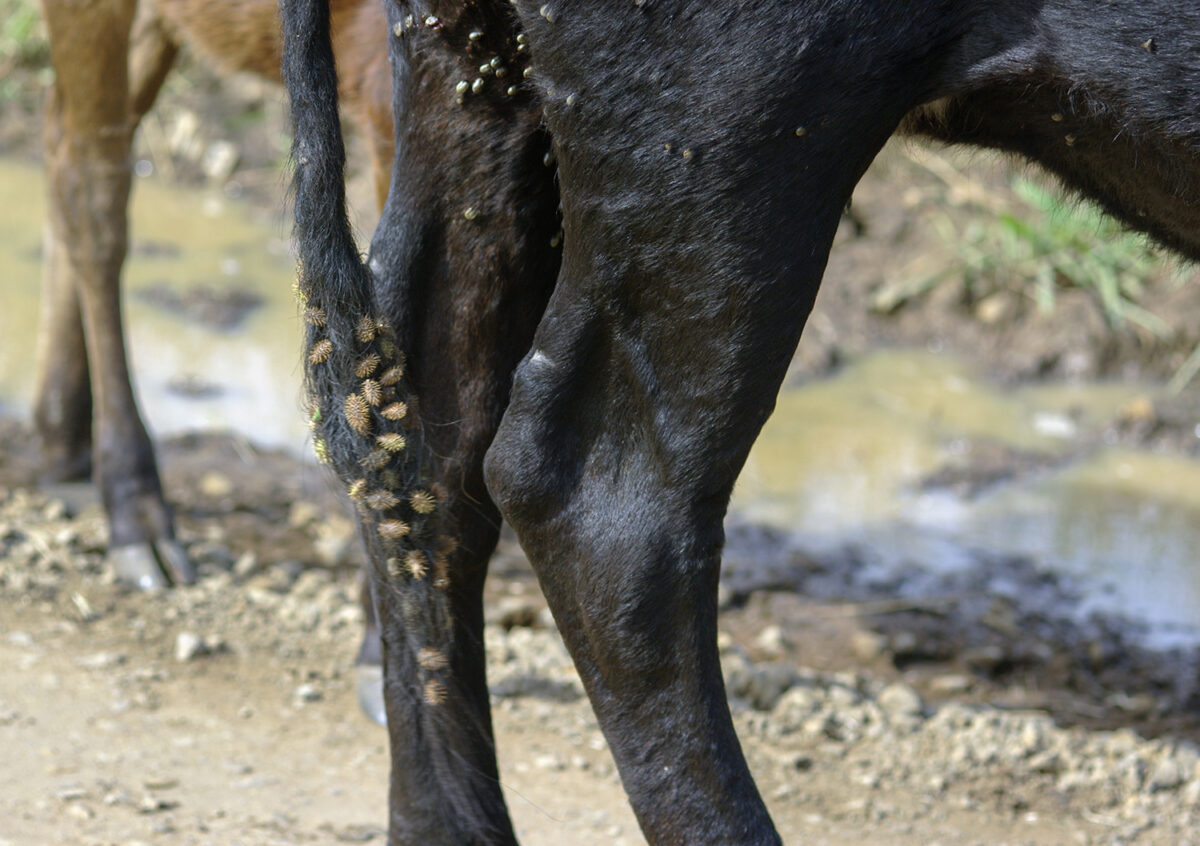
Ticks remain the most threatening parasites in cattle farming because they cause both direct and indirect harm. Direct effects include blood loss, local irritation, abscess formation, and reduced appetite. Indirect effects result from the transmission of tick-borne diseases, which can lead to significant disease and mortality.
Gastrointestinal Worms: The Hidden Production Thieves
There is some good news regarding cattle: GI worms tend to be less problematic than in small stock. While worm-related deaths in cattle are fewer, they are responsible for substantial economic losses due to decreased production.
The most important GI worms are the gastrointestinal nematodes (GIN). The most important GIN of cattle are the brown stomach worm (Ostertagia spp.), the bankrupt worms (Cooperia spp. and Trichostrongylus spp.) and the cattle wireworm (Haemonchus placei). Calves are also more severely affected by GIN compared to adults. In marshy areas, liver flukes (Fasciola spp.) are also a major challenge.
GINs inhabit the milk stomach (abomasum) and small intestine, feeding either on blood or on gastrointestinal tissue and fluids. This leads to loss of nutrients and inflammation, further compromising nutrient absorption and utilisation.
Typical signs include reduced appetite, increased passage of undigested nutrients, reduced weight gain, immune suppression, and decreased fertility. More severe cases typically progress to anaemia (decreased red blood cells seen as pale mucous membranes), diarrhoea, and anorexia. In those with severe GIN infestation, death is also not an uncommon finding.
Liver flukes primarily inhabit and damage the liver. Signs include reduced production, lower milk yield, and the development of anaemia and bottle jaw over time. Severe cases may result in mortality. At slaughter, all infested livers are condemned at abattoirs.
Ticks: The ultimate multi-threat parasite
South Africa’s climate is highly favourable for tick populations, making them a persistent challenge for cattle farmers. The two blue ticks — African blue tick (Rhipicephalus decoloratus) and Asiatic blue tick (R. microplus) — are the most economically significant. These species transmit multiple tick-borne diseases. The Asiatic blue tick transmits both African and Asiatic redwater as well as anaplasmosis (Anaplasma marginale also known as tick-borne gall sickness). The African blue tick transmits African redwater and two Anaplasma species (A. centrale and A. marginale). All these diseases can cause mortality. Asiatic redwater is the most severe, followed by African redwater and anaplasmosis.
What makes these ticks particularly problematic is their reproductive capacity. They can complete their entire life cycle in as little as two months. This means that they can complete multiple life cycles per year, resulting in heavy infestations. Each engorging female tick may cause the loss of 1g of bodyweight and 1ml of milk production per day per animal. Severe infestations involving hundreds of adult females can therefore cause substantial production losses.
Another economically significant tick is the bont tick (Amblyomma hebraeum). It transmits heartwater (Ehrlichia ruminantium) and causes severe tissue trauma to teats, udders, testes, and the sheath. Secondary bacterial infections and abscesses are common. Damage to the udder can permanently reduce milk production; damage to the testes may cause infertility, and sheath damage can impair a bull’s serving ability. Heartwater itself is also a highly fatal tick-borne disease if not treated promptly.
To put this into perspective, accurate and up-to-date data for South Africa is unfortunately limited. However, reliable figures are available from other countries. For example, to illustrate the scale of potential losses, Brazil experiences approximately 13.96bn American dollars in annual economic losses, accounting solely for production and economic impacts directly attributable to parasitic infestations in cattle.
Recognising the early warning signs
From a practical farm perspective, veterinarians and farmers should watch for specific clinical signs when parasite burdens are starting to compromise cattle health. The earliest clinical signs tend to be parasite-specific diseases as discussed previously. However, in areas where animals have developed resistance to these diseases, the signs of parasitic burden usually present as reduced production — lower-than-expected average daily gain or poorer fertility. Another possible indicator is an increase in non-parasite-related diseases due to parasite-induced immune suppression.
Some uncommon manifestations that I’ve encountered include individual calves performing poorly while the rest of the herd maintains condition. This may indicate inadequate milk production caused by tick damage to the teats or udder of individual animals not experiencing any other obvious signs of parasitic infestation. A subtle decline in feed intake may also suggest parasitism, although this is difficult to measure outside intensive feeding systems.
The economic reality: Quantifying production losses
When discussing the most significant production losses linked to parasitism in commercial cattle, mortalities top the list. Losing an animal is not only a direct financial loss; it also represents the loss of future breeding potential, genetics, and all the resources already invested. However, chronic parasite burdens and marginally reduced fertility and appetite across an entire herd over a season may be equally catastrophic.
These seemingly small, often unnoticed production losses multiply dramatically when compounding across a herd and over time. It is crucial not to view parasitism in isolation but to consider the entire production system as a whole.
The growing challenge of resistance
Anthelmintic resistance is a major local challenge that is regularly encountered on farms. In South Africa, resistance is more extensively documented and investigated in small stock, partly because small stock are more susceptible to the effects of GIN. However, this does not mean that gastrointestinal worms in cattle do not exhibit resistance.
Resistance can only be definitively diagnosed through faecal egg count reduction tests. Apparent treatment failure or high parasite loads alone cannot confirm resistance, but they warrant investigation. Specific laboratories, such as the Afrivet lab in Howick, can perform these tests and provide advice on resolving the problem.
Acaricide resistance is also a major problem. Recent research reports marked resistance in one-host ticks across most of their distribution in South Africa. There is also significant resistance in multi-host ticks across large portions of their distribution as well. The Afrivet lab can test both ticks and dip wash to confirm resistance and verify correct compound concentrations.
Understanding how resistance develops is crucial for prevention. Resistance development is influenced by parasite, environmental, and management factors. Natural genetic variation ensures that some parasites inherently carry resistance traits. When antiparasitic remedies are used, susceptible parasites die while resistant ones survive and reproduce, gradually increasing their proportion in the population. In effect, we are selecting for resistant parasites — much like selective breeding.
Resistance develops faster when products are underdosed, incorrectly diluted, poorly applied, counterfeit, or stored improperly after opening (it is advised not to store open antiparasitic remedies). Reduced efficacy leads to more frequent treatments, increasing selection pressure and accelerating resistance — a self-reinforcing cycle.
In short, resistance is inevitable, but management practices can either accelerate or delay its development. We must act as responsible custodians of the antiparasitic remedies available to us.
A strategic approach to parasite management
When it comes to strategic deworming and integrated parasite management, especially in herds operating in warm, humid, summer-rainfall areas, my approach is built on three foundational recommendations.
First, work closely with the local herd veterinarian, who best understands regional conditions and challenges. Second, accurately diagnose and quantify parasite burdens. Third, follow the principles outlined by Prof Gareth Bath in The Big Five – Implementing Sustainable Holistic Internal Parasite Management In Sheep And Goats, which form the foundation of integrated parasite management.
Ticks are also addressed in the Food and Agriculture Organization’s guidelines for sustainable tick control and acaricide resistance management in livestock. These frameworks contain principles that are broadly applicable across livestock systems and can be adapted by farmers and veterinarians based on laboratory diagnoses and local conditions.
Two interconnected concepts lie at the heart of integrated parasite management: Refugia and rotation of active ingredients. Refugia refers to the population of susceptible parasites not exposed to treatment — either in the environment or on untreated animals. Maintaining a substantial refugia population helps ‘dilute’ resistant parasites so that most parasites exposed to treatment remain susceptible.
Rotating active ingredients is also crucial. Individual parasites are rarely resistant to multiple active ingredients. Parasites surviving one treatment may die when exposed to a second active substance. Rotating actives while maintaining adequate refugia helps delay the development of resistance.
Beyond medicines: Building system-wide resilience
This brings me to what I consider an exceptionally important aspect of parasite control: The role of nutrition, grazing management, and herd immunity. This multi-faceted approach is necessary for sustainable parasite control because antiparasitic remedies kill only susceptible parasites while increasing the proportion of resistant ones. Therefore, integrating grazing management, nutrition, and immunity is essential.
Grazing management is one of the most powerful tools in parasite control. Each parasite has a unique life cycle and environmental survival strategy. By understanding these cycles, farmers can target vulnerabilities. For example, liver fluke infestations occur in wet, marshy areas. Avoiding these areas during high-risk periods prevents exposure to larvae. Another strategy is extended resting of camps without susceptible hosts, allowing parasite numbers to decline naturally. Multi-species grazing can also reduce pasture contamination — sheep, for instance, will deposit Haemonchus contortus larvae, and cattle grazing afterwards ‘vacuum up’ larvae to which they are not readily susceptible.
Herd immunity and nutrition are closely interlinked when it comes to parasite resistance. In order for an animal to launch an immune response, it needs to be in a good nutritional state. It requires energy, protein, vitamins, and minerals to be able to mount an effective immune response. Without these building blocks to support bodily and metabolic functions, no animal can have a functioning immune system.
Herd immunity can be seen as a collective genetic resilience against parasites that is realised when adequate nutrition is available. Genetics determine the extent to which an animal can mount an immune response and how inherently resistant they are to parasitic infestations. Prof Bath explains herd immunity with ‘stop selecting sissy sheep’. This perfectly captures the importance of good genetic selection for parasite resistance.
Conclusion
Managing parasites in cattle is not about finding a single magic solution — it is about understanding the complex interactions between parasites, cattle, and their environment, then implementing a holistic approach that combines strategic medication use with sound management practices. By working together — farmers, veterinarians, and researchers — we can build more resilient cattle operations that are both productive and sustainable. The key is to remain vigilant, adaptable, and committed to being responsible stewards of the tools at our disposal.
References
Bath GF. The “BIG FIVE”: A South African perspective on sustainable holistic internal parasite management in sheep and goats. Small Ruminant Research, 2014.
FAO. 2025. Guidelines for sustainable tick control and acaricide resistance management in livestock. FAO Animal Production and Health Guidelines, No. 38. Rome. https://doi.org/10.4060/cd4964en
FAO. 2025. Guidelines for sustainable tick control and acaricide resistance management in livestock – Technical documentation. Rome. https://doi.org/10.4060/cd5440en
Horak IG, Evans U, Purnell RE. Parasites of domestic and wild animals in South Africa. XLV. Helminths of dairy calves on dry-land Kikuyu grass pastures in the Eastern Cape Province. Onderstepoort Journal of Veterinary Research, 2002.
Jaja IF, Mushonga B, Green E, Muchenje V. Seasonal prevalence, body condition score and risk factors of bovine fasciolosis in South Africa. Veterinary and Animal Science, 2017.
Jaja IF, Wanga-Ungeviwa P. A 6-year retrospective report of livestock parasitic diseases in the Eastern Cape Province, South Africa. Open Veterinary Journal, 2022.
Makwarela TG, Nyangiwe N, Masebe T, et al. Tick diversity and distribution of hard (Ixodidae) cattle ticks in South Africa. Microbiological Research, 2023.
Strydom T, Lavan RP, Torres S, Heaney K. The economic impact of parasitism from nematodes, trematodes and ticks on beef cattle production. Animals, 2023.