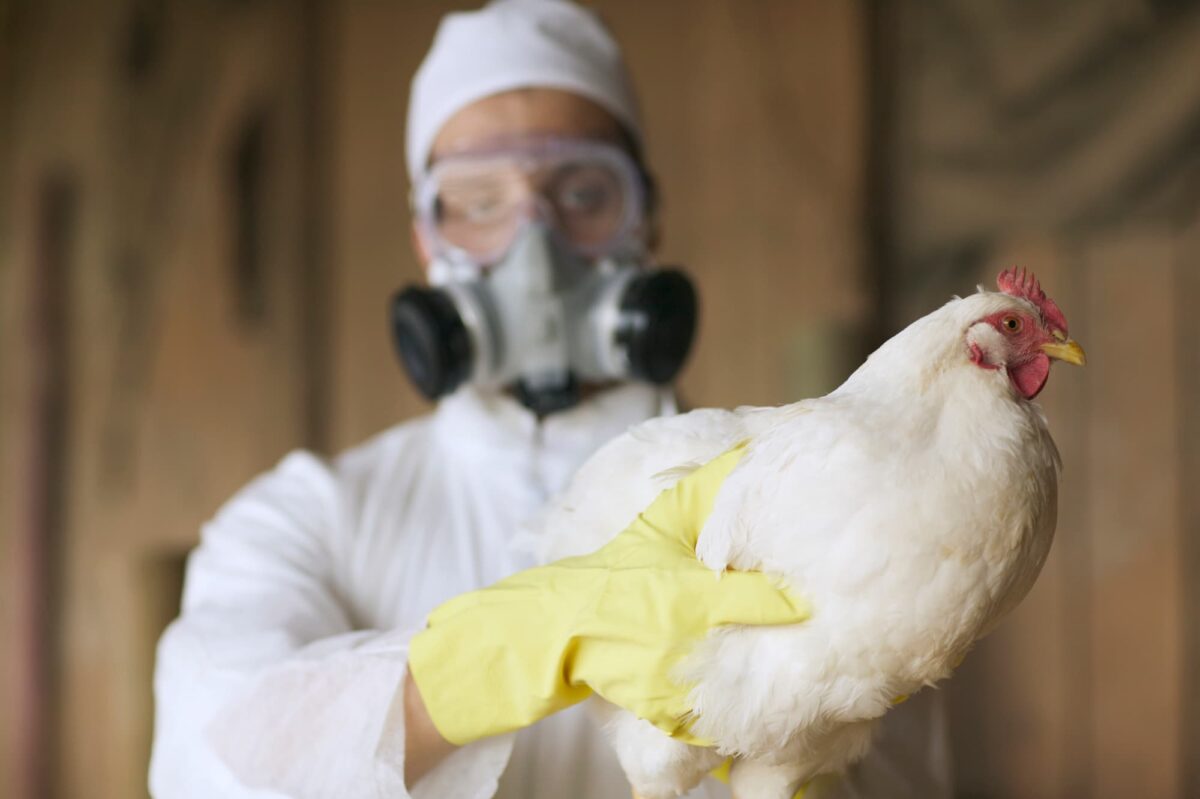
Highly pathogenic avian influenza (HPAI) is a severe, systemic and highly contagious viral disease of poultry. No single clinical sign is unique to HPAI, and the disease can present in several ways depending on the virus strain, the species of bird, the age of the flock and environmental conditions.1
However, a defining feature is rapid, escalating and often unexplained mortality. In unvaccinated flocks, mortality can reach up to 100%, and sudden death may occur without any preceding visible signs, particularly in peracute infections. Birds may be found dead with no apparent cause, making early detection challenging without active surveillance.1
In affected flocks, birds often show pronounced systemic illness. Listlessness, a marked reduction in feed and water intake, reduced vocalisation and diarrhoea are common. Respiratory signs may include nasal and ocular discharges, coughing, sneezing and open-mouth breathing.1
Swelling of the head, eyelids, comb, wattles and hocks may develop, along with cyanosis — a purple-blue discolouration of the unfeathered skin. In some cases, nervous signs such as incoordination and neurological abnormalities are observed. In laying birds, a sharp drop in egg production and the appearance of soft-shelled, misshapen or depigmented eggs are frequently reported.1
When bird flu takes a devastating toll
In South Africa, the clinical picture has been consistent with these descriptions. During the 2021–2023 outbreaks, neurological signs were observed in wild coastal seabirds, including head twitches and seizures, and an Egyptian goose was also reported showing neurological abnormalities. In poultry, outbreaks were characterised by rapid and high mortality, particularly in layer chickens. A single high-mortality outbreak was also documented in ostriches in the Free State. The 2023 outbreaks involved both H5N1 and H7N6 strains, adding further complexity to diagnosis and control.2
The scale of mortality in South Africa has been significant. Approximately 1.75 million chickens were culled in 2023 alone as a disease control measure. Over the period from 2017 to 2023, a cumulative total of 13 million birds were culled across three major outbreak waves — H5N8 in 2017, H5N1 in 2021, and both H5N1 and H7N6 in 2023 — with no compensation provided to farmers under the Animal Diseases Act. More than 2.5 million broiler breeder birds were lost in the 2023 outbreak, representing approximately 30% of the national broiler breeding flock, with 95% of all broiler breeders in the greater Gauteng region culled.3
Treatment: Why there is no cure
There is no specific treatment for HPAI in poultry. Antiviral drugs used in human medicine, such as neuraminidase inhibitors and M2 ion-channel inhibitors, are not used in poultry production and are not a recommended control measure.2
Analysis of the South African H5N1 sequences from 2021–2023 found no neuraminidase mutations that would confer resistance to neuraminidase inhibitors, but the M2 S31N mutation, which reduces susceptibility to amantadine and rimantadine, was detected in a small number of previously sequenced viruses. These findings underscore that antiviral resistance is a live concern and that medication is not a viable substitute for prevention and biosecurity.2
The focus of disease management therefore remains on prevention, early detection and containment rather than treatment of affected birds. Once HPAI is confirmed in a flock, the standard control measure has been stamping out — culling all birds on the affected premises, whether infected or apparently healthy, followed by thorough cleaning and disinfection before restocking.1
While this approach can limit further spread, it carries enormous economic and welfare costs, and the South African experience has demonstrated the toll it takes on producers who receive no compensation for their losses.1,2
Vaccines: A new line of defence
Vaccination is now emerging as a central pillar of South Africa’s revised HPAI control strategy. Under the new regulatory framework, vaccination will form part of a broader approach combining vaccination, biosecurity and testing.4,5
The government’s strategy is built on four pillars: controlled vaccine use using only officially registered vaccines, with farmers required to register and follow strict protocols; improved on-farm biosecurity; full traceability of vaccinated flocks to protect export markets; and continuous surveillance for rapid response to new outbreaks. Three H5 vaccines are already registered, and an H7 vaccine is in development.5
The urgency of vaccination was highlighted during the 2023 outbreak, when the broiler industry called for a fast-tracked registration process so that replacement breeding stock could be protected against future H5 and H7 events. At that time, vaccine dossiers covering both H5 and H7 covering H7, and covering H7 were at various stages of evaluation and production. The industry argued that vaccination was critical to prevent further devastating losses of breeding stock, particularly with the approaching winter season, which poses a recurrent risk for HPAI outbreaks.3
The shift from stamping out to controlled vaccination represents a fundamental change in approach. Rather than destroying entire flocks after the virus arrives, the aim is to protect birds proactively and reduce the need for mass culling while maintaining effective disease surveillance.3
The strategy also draws on international experience — in Mexico, for example, the H7 vaccine is mandated for use to eradicate the H7 virus, demonstrating that vaccination can be integrated into national eradication programmes. For South Africa, where the industry has already lost 13 million birds with no compensation, the move offers a path towards safeguarding both animal welfare and the economic sustainability of poultry production.3
Biosecurity remains the foundation on which vaccination is built. Preventing contact between domestic poultry and wild birds, particularly waterfowl, using dedicated clothing and footwear, disinfecting equipment and vehicles, restricting farm visitors, and sourcing feed and water from safe supplies are all essential measures.1
Vaccination does not replace biosecurity — it complements it. When combined with active surveillance, rapid reporting, movement controls and traceability, vaccination offers a more sustainable and humane approach to managing HPAI than mass culling alone.1
HPAI on the farm: 5 messages that matter
- Report sudden or unexplained mortality immediately. Rapidly increasing deaths, particularly without obvious preceding signs, should raise suspicion of HPAI and prompt urgent investigation and reporting.
- Know the clinical warning signs. Watch for reduced feed and water intake, lethargy, respiratory signs, diarrhoea, swelling or cyanosis of the head and comb, neurological abnormalities and sudden drops in egg production.
- Do not rely on treatment. There is no specific treatment for HPAI in poultry. Prevention, early detection and rapid containment are essential, and antiviral drugs used in human medicine are not a substitute for effective disease control.
- Make biosecurity non-negotiable. Minimise contact with wild birds, particularly waterfowl; use dedicated clothing and footwear; disinfect equipment and vehicles; restrict visitors; and ensure feed and water supplies are protected from contamination.
- Understand that vaccination complements — not replaces — biosecurity. Farmers should use only officially registered vaccines and comply with vaccination, testing, traceability and surveillance requirements as part of South Africa’s revised HPAI control strategy.
Conclusion
Highly pathogenic avian influenza remains a major threat to poultry health, animal welfare and the sustainability of South Africa’s poultry industry. Its rapid progression and potentially devastating mortality make early detection, surveillance and effective biosecurity essential. With no specific treatment available, control has traditionally relied on stamping out, resulting in substantial losses for producers. South Africa’s move towards controlled vaccination, alongside biosecurity, testing, traceability and surveillance, represents an important shift towards proactive disease management. Vaccination will not replace biosecurity, but together these measures offer a more sustainable approach to reducing transmission, protecting flocks and limiting the need for large-scale culling during future outbreaks.
References
- World Organization for Animal Health. Avian Influenza. [Internet]. Available at : https://www.woah.org/en/disease/avian-influenza/
- Abolnik C, Roberts LC, Strydom C, et al. Outbreaks of H5N1 High Pathogenicity Avian Influenza in South Africa in 2023 Were Caused by Two Distinct Sub-Genotypes of Clade Viruses. Viruses, 2024.
- Breitenbach I. Highly Pathogenic Avian Influenza 2023.Portfolio Committee: Agriculture, Land and Rural Development. 20 October 2023. [Internet]. Available at:https://pmg.org.za/files/231020_HPAI_Presentation.pptx
- Global Ag Media. South Africa greenlights bird flu vaccine rollout. 2025 [Internet]. Available at: https://www.thepoultrysite.com/news/2025/06/south-africa-greenlights-bird-flu-vaccine-rollout
- South African Government. Minister John Steenhuisen intervenes to support poultry industry with new avian influenza vaccination policy. 2026 [Internet]. Available at: https://www.gov.za/news/media-statements/minister-john-steenhuisen-intervenes-support-poultry-industry-new-avian