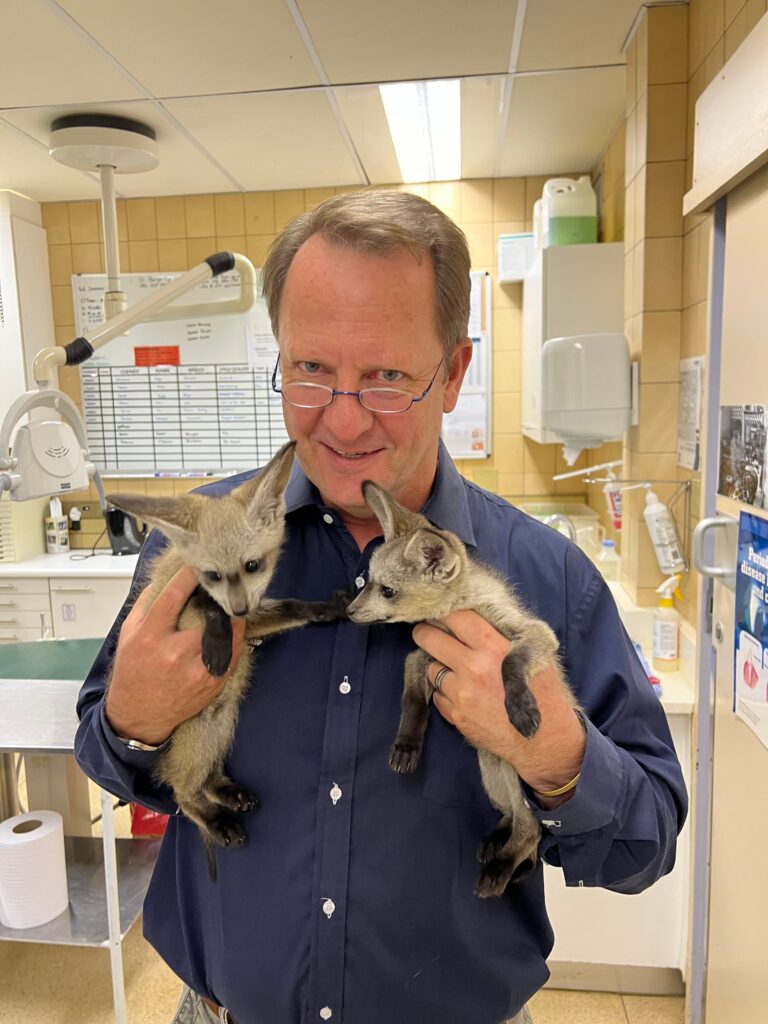
Once a niche area within veterinary medicine, animal dentistry has evolved into a dynamic discipline that bridges anatomy, evolution, and conservation. Prof Gerhard Steenkamp, based at the Small Animal Surgery at Onderstepoort Veterinary Hospital, University of Pretoria, reflects on the field’s remarkable journey – from its experimental beginnings to its growing role in advancing both animal welfare and scientific understanding.
Veterinary dentistry is one of the newer fields of veterinary science and only dates back to the middle/late 1980’s, Prof Steenkamp explains. Dentists up to that point were often asked to help with animals on an ad hoc basis. As more veterinarians became involved in the field, it was only natural that we would expand into all the creatures we work with. From those early days, the discipline quickly evolved.
“We realised that all animals, especially those in captivity, do suffer from dental and maxillofacial disease and from time to time will require treatment,” he says.
Today, the field is as diverse as the animal kingdom itself — from tiny rodents to elephants with tusks that weigh more than most humans.
Tooth tales: Evolution’s blueprint
Understanding animal teeth is not just about fixing fractures — it is about tracing millions of years of evolution.
“Comparative odontology is the study of dental evolution, comparing tooth structures, their development, and functions across different species to understand their evolutionary adaptations and relationships,” Prof Steenkamp says.
He insists that knowledge of form and function must precede treatment. “Before you can treat any tooth, you need to understand its origin and function. By doing this you can restore the function of the tooth. Aesthetics does not play any role in the work we do — it’s all about making the animal comfortable in order to continue with its normal function and doing so pain-free.”
Skulls, secrets, and the struggle for data
Behind every dental textbook lies a museum’s worth of skulls — or at least, there should be. “Access to well-preserved skulls of which all the metadata is available,” he explains, “is crucial. Ageing of these skulls is often non-existent and this will cause problems in interpreting pathologies.”
Accurate anatomical data is the cornerstone of wildlife dentistry, yet it is often the hardest thing to find. Without it, researchers cannot fully understand species-specific dental disease — or design better treatments for animals in captivity.
When a toothache turns deadly
A chipped molar may sound minor, but in the wild, it can mean the difference between life and death. “Fractured teeth with pulp exposure will initially cause pain which will cause the animal to eat less. Chronic pain will also make the animal socialise less than normal,” Prof Steenkamp says.
For predators, pain can reduce hunting efficiency. For herbivores, it can lead to malnutrition. Interestingly, he adds, there are no dental conditions that are more prevalent in wildlife than in domestic animals — it is rather the other way around. Captivity, diet, and stress, it seems, make domesticated animals more prone to dental issues than their wild cousins.
Extract or preserve? Function rules
When it comes to treatment decisions, Prof Steenkamp applies a simple philosophy. “It is all about function and being pain-free. Those are the two most important factors for me.”
Whether it is a cheetah’s canine or a rhino’s molar, he evaluates one thing above all else — can the animal live and feed without pain? If not, the tooth must go.
Tusk talk: Nature’s ingenious tools
“The obvious ones are the warthog and the elephant,” he says, when asked about fascinating dental adaptations. “Both animals have teeth (tusks as they are outside the oral cavity), but they play no part during mastication of food. Their tusks are utensils developed for digging and debarking trees.”
These examples show that teeth are far more than eating instruments — they are tools of survival, weapons of defence, and, in some cases, social status symbols.
Crocodile clues and regenerative dreams
Few species capture the imagination of comparative odontologists quite like crocodiles. “This has been an avenue for research for many years,” Prof Steenkamp notes. “It stands to reason that if we can incorporate those genes that are responsible for continuous tooth production in crocodiles into humans, we can preserve the dentition in humans for a longer period of time.”
But it is not that simple. “There will always need to be some switch on/switch off mechanism involved.” Still, the idea that a reptile could one day inspire permanent human teeth is a thrilling thought for both medical and dental researchers.
When diet and dentistry collide
If there is one rule in nature, it is that you are what you eat. “Form follows function,” says Prof Steenkamp. “Animals have teeth that are adapted to the normal diet they should be eating. In captivity we often have to give different diets as the normal diet is not available. This can lead to an increase in dental wear and dental disease.”
He offers a striking example: “Aardvark, which are myrmacophageous (eats ants) and especially of the Formicidae family — the formic acid helps to keep the oral cavity healthy. In captivity they are often fed diets containing mince and eggs and they are renowned to develop dental abscesses. The same with black rhinos, who are browsers, being fed a grazer diet. The dental wear in these species in captivity has been shown to be abnormal.”
Captive diets, while nutritionally balanced, can undermine the natural cleaning mechanisms wild diets provide — a reminder that even the best intentions can have unintended consequences.
Post-extraction: The healing touch
Once a tooth is gone, the challenge becomes recovery. “In captivity these animals are seen daily, and adequate pain relief and diet adaptation can be done to make sure they are comfortable and maintain their daily dietary requirements,” Prof Steenkamp says.
Pain management, observation, and diet modification are key to ensuring smooth recovery — luxuries not afforded to animals in the wild.
Veterinary dentistry: The ultimate team sport
“Veterinary dentistry has really exploded over the last 30-years,” he reflects. “Initially there was tremendous input from dentists, but today veterinarians specialising in dentistry and especially zoo and wildlife dentistry have developed the necessary skills to treat our patients.”
The field has become deeply collaborative. “There are also other branches in the veterinary field that we use commonly like anaesthetists and radiologists. I maintain veterinary science is a ‘team sport’. We need to work together to ultimately treat the animal as best as we can.”
This teamwork extends beyond the hospital – to engineers, conservationists, and even geneticists.
Engineering bigger, better, kinder tools
“Every year people are coming up with new ways of treating dental disease in wildlife. The main development is on equipment, especially equipment needed for large animals. Here collaboration with engineers is essential,” Prof Steenkamp explains.
From designing tools capable of handling an elephant’s molar to creating lightweight devices for field dentistry, innovation is redefining what’s possible in animal care.
Training tooth tamers
Not every veterinarian leaves university ready to perform dental surgery on a leopard. “I do not believe that dental treatment of wildlife is part of the day one competency of a veterinary student,” he says. “Of course, most faculties train them on the dental treatment of small carnivores (dogs and cats) as well as equids. These basic principles can be employed on many wildlife species.”
Real expertise takes years. “To become experienced in wildlife dentistry takes time and is dependent on what you get exposed to and where you work. Some of us do give lectures and wet labs at conferences to veterinarians to expose them to the finer nuances.”
Guardians of the guardians
Wildlife dentistry even plays an indirect role in conservation. “Firstly, we make sure the patrol dogs used for anti-poaching remain healthy and their dental health is part of this. With them healthy they can perform their duties well and in so doing help save our wildlife. Secondly, we play a role in conservation breeding programs where you want to make sure all breeding animals are as healthy as possible (dental health included) to make sure they can breed at an optimal rate.”
Healthy teeth, healthy ecosystems — it is a connection few outside the field would ever consider.
First, do no harm
Ethics underpin everything. “Scientific accuracy is non-negotiable. As veterinarians we live by the motto of ‘First do no harm’. If I cannot prove a treatment safe and beneficial for animals, I will refrain from performing it.” It is a principle that keeps veterinary dentistry grounded, even as it expands into uncharted scientific territory.
An elephant, a tooth, and a genetic secret
Few stories illustrate the field’s scientific crossover quite like one of Prof Steenkamp’s most memorable cases. “A few years ago, scientists came to remove some of the periodontal ligament tissue from a tusk I had to extract on an elephant. This tissue was used in research to prove elephants have multiple p53 genes.”
The finding was extraordinary. “These genes are very important to suppress abnormal division of cells which can form cancer. Humans only have one of these genes and elephants up to 10. This possibly helps us to understand why they develop very few tumours compared to humans which live nearly as long.”
What began as a dental extraction became a contribution to global cancer research — a testament to the unexpected intersections of veterinary science.
The future
Looking ahead, Prof Steenkamp’s optimism is contagious. “Future research is really going to be bound by our imagination and money. We will keep on expanding our knowledge from the species we see commonly to those we see less common. Together with the dentistry knowledge, we will also learn more about safe anaesthesia protocols for animals we do not anaesthetise frequently or those that are simply difficult to anaesthetise.”
As the tools, techniques, and technology continue to advance, veterinary dentistry is no longer just about saving teeth — it is about improving lives, preserving species, and unlocking the evolutionary secrets hidden behind every bite. Or as Prof Steenkamp puts it, simply and powerfully: “It’s all about function and being pain-free.”