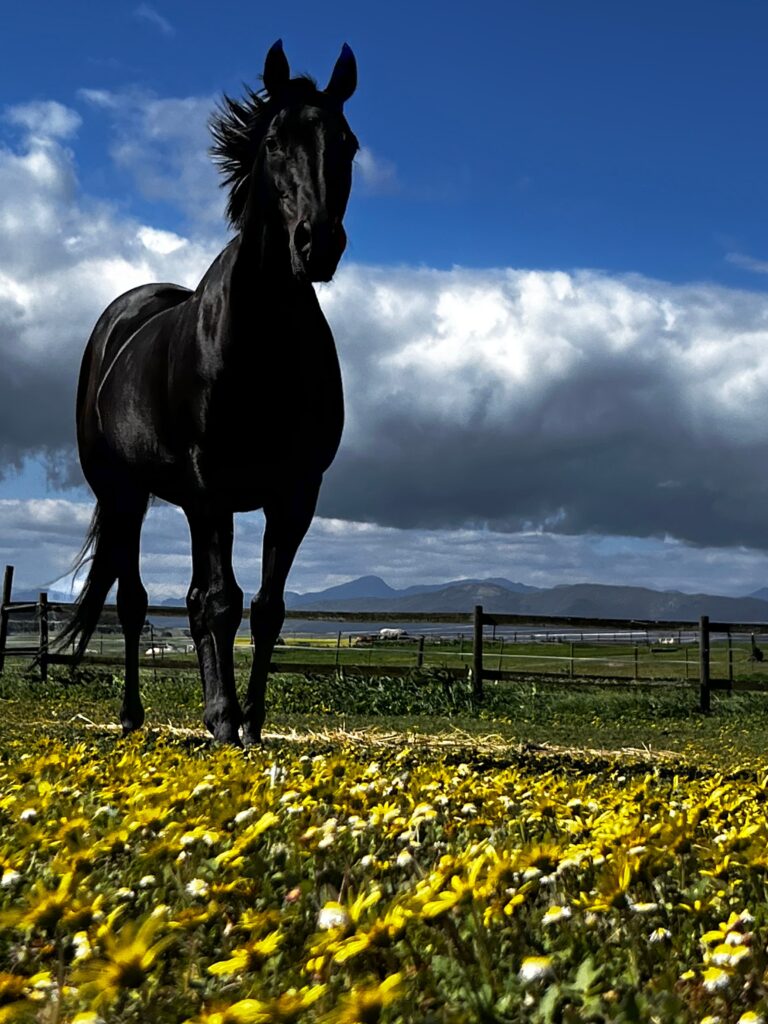
Overriding dorsal spinous processes (ODSP), commonly known as ‘kissing spine’, is a condition that affects horses across all breeds and disciplines. Performance horses, particularly Thoroughbreds, are at higher risk due to the physical demands of their work. Many horses with radiographic changes show no overt signs of discomfort, masking the condition until changes in behaviour or performance become apparent.1
Jill Smith* is an experienced rider with extensive hands-on experience across multiple equestrian disciplines. After her own horse was diagnosed with ODSP, she developed a keen interest in equine biomechanics and transitioned into a career in saddle fitting. Her combined professional expertise and personal experience managing her horse’s wellbeing give her a unique perspective on the challenges riders face when addressing back pain and performance issues.2
Initially, her horse was calm and sensible, helping her regain confidence and strength. “He was strong, happy, and loved his job, remaining in full work,” Jill recalls. However, a year later, an unrelated injury forced her to take six months off riding. During that time, her horse enjoyed a five-month paddock holiday. When work resumed, his behaviour had changed noticeably — he began rushing, bucking, and showing unusual spookiness.2
“It was immediately clear something was not right. When asked for canter, he bucked repeatedly on the spot. Knowing this was not his personality, we called the vet the next day,” Jill recounts. X-rays confirmed the diagnosis: kissing spine. The horse had likely carried the condition for years, but full muscular tone had masked it until prolonged rest allowed pain to manifest.2
Dr Gottschalk weighs in: Prevalence and risk
Dr Roy Gottschalk, a specialist equine surgeon at Witbos Veterinary Clinic, an equine-focused facility established in 1988, explains that ODSP are prevalent across all breeds and disciplines. 1
“Thoroughbreds, Warmbloods, and Quarter horses show the highest prevalence. It is most often diagnosed in performance horses because of the high physical demands placed on their backs,” he says.1
While close-coupled, short-backed horses were once thought more prone to ODSP, Dr Gottschalk notes: “We commonly see it in horses of all shapes and sizes.” 1
Interestingly, many horses with radiographic ODSP show no overt signs of back pain. “Incidental findings are common. We usually x-ray the backs of horses showing clinical signs, so we may miss asymptomatic cases,” Dr Gottschalk explains. However, as horses progress in their athletic careers, even incidental kissing spine can become clinical. 1
Reading the signs: Behavioural clues
Jill’s experience underscores a critical point: Sudden behavioural changes are often pain signals. 2
“Lesson learned: If a horse is difficult or changes behaviour drastically, it is not necessarily a sign of bad manners, but a way of telling you they’re in pain,” she emphasises.2
Clinical presentation varies but often includes resistance to girthing, difficulty engaging hind limbs, back pain, and subtle behavioural changes such as spookiness or reluctance to move forward. Adjacent back muscles may appear underdeveloped, and range of motion is reduced, says Dr Gottschalk.1
He stresses the importance of thorough evaluation. “A detailed history, clinical examination, and appropriate imaging are essential. Ultrasound helps evaluate ligaments and bone positioning, while scintigraphy is rarely used due to cost and interpretive variability,” he explains. 1
Imaging and diagnosis: X-Rays lead the way
X-rays remain the cornerstone for diagnosing ODSP. “We look for dorsal spinous processes that are too close together or overlapping. However, imaging alone is not enough —correlation with clinical findings is crucial,” Dr Gottschalk notes. Diagnostic local anaesthesia can sometimes help confirm if lesions are causing pain, though false negatives are common.1
Jill’s horse illustrates the interplay between imaging and clinical presentation. Though he had likely harboured the condition for years, his good muscle tone had prevented pain, masking clinical signs until he was rested for an extended period.2
Breaking the pain cycle: Conservative management
Dr Gottschalk emphasises that the first line of treatment is often conservative. “The essential intervention is breaking the pain cycle and implementing an exercise program to strengthen muscles around the spine. This allows the horse to move pain-free.” 1
An exercise programme is usually combined with proper saddle fitting and, in some cases, a lighter or more balanced rider. Extracorporeal shockwave therapy (ESWT) is extensively used with good results. “Focused, high-energy shockwaves applied based on imaging are non-invasive, analgesic, and help the horse recruit muscles around the spine,” he explains.2
Where ESWT is not feasible, corticosteroids can be used to reduce inflammation. However, this carries risks, including fibrosis or infection, and may affect eligibility in competitive events. Other interventions like mesotherapy are occasionally used for nerve-related pain, though Dr Gottschalk notes limited personal experience. 1
Jill adds perspective from the rider’s side: “Working with a knowledgeable veterinarian and understanding the horse’s needs is crucial. Even after treatment, patience and consistent work are key to rebuilding strength and confidence.” 2
When surgery becomes necessary
Surgical intervention is reserved for cases where conservative treatment fails, or the horse is unrideable. Dr Gottschalk outlines the main surgical options: Subtotal ostectomy and interspinous ligament desmotomy (ILD). Subtotal ostectomy removes a portion of the dorsal spinous process while preserving sufficient bone for muscle attachment. ILD involves cutting the ligament and nerves between the dorsal spinous processes, indicated when there is enough space to safely insert instruments. 1
“Minimally invasive standing ILD can improve recovery times but isn’t suitable for advanced cases with overlapping or bony changes, which may require ostectomy,” Dr Gottschalk clarifies. Recovery outcomes across surgical techniques are similar, with 70%-80% of horses returning to work. 1
Crucially, he stresses: “Owner and rider compliance with the rehabilitation programme is integral. Surgery alone is not enough. The horse must regain strength and mobility for a successful return to performance.” 1
Rehabilitation: Strengthening for success
Exercise, physiotherapy, and core strengthening are essential components of management. Dr Gottschalk notes: “Exercise aimed at back and core muscles helps get the back mobile and strong. Without addressing the pain cycle, other treatments are unlikely to succeed.” 1
Jill confirms this: Rebuilding his muscle tone and confidence took time. It was not just about riding. It was about structured, consistent work and paying attention to his responses.2
A multidisciplinary approach — including saddle fitting, physiotherapy, and targeted exercise — is often the most effective. Even lighter or balanced riders can help in the rehabilitation process. 1
Recognising risk factors and breed considerations
Dr Gottschalk highlights breed-specific risks. “Thoroughbreds are at higher risk due to their athletic demands, but we see ODSP in Warmbloods, Quarter horses, and other breeds. Close-coupled horses may be predisposed, but it occurs in all shapes and sizes.” 1
Performance level also plays a role. Horses in high-demand disciplines are more likely to show clinical signs. However, even horses living in near-natural conditions can have ODSP with minimal clinical manifestation.1
Insights for riders: Lessons from Jill
Jill’s experience illustrates key takeaways for horse owners and riders: 2
- Changes in behaviour are often pain signals, not stubbornness.
- Muscle tone can mask the severity of ODSP until rest or reduced work reveals symptoms.
- Close communication with a knowledgeable veterinarian is critical.
- Patience and a structured rehabilitation program are essential for recovery.
“Understanding your horse and their history, combined with proper diagnostics, can make all the difference. Even when the horse appears fine, subtle signs should not be ignored,” she adds.2
The future of ODSP management
Dr Gottschalk concludes with a forward-looking perspective: “ODSP has always existed, but advances in imaging allow us to diagnose more accurately and earlier. As research provides better evidence, treatment protocols can be refined, and outcomes for horses will continue to improve.” 1
He underscores the importance of horse welfare: “Every decision — whether conservative, surgical, or rehabilitative — must prioritise the horse’s health and comfort. Evidence-based decisions are key, but individual circumstances guide the best course of action.” 1
Final thoughts
Kissing spine is a condition that can affect horses silently until performance or behaviour changes signal discomfort. Jill’s journey highlights the rider’s perspective: Awareness, patience, and collaboration with veterinary professionals are essential. Dr Gottschalk’s expert insights provide a clear roadmap for diagnosis, treatment, and rehabilitation, underscoring the importance of a multidisciplinary, evidence-based approach. 1,2
By recognising early signs, understanding breed and performance risks, and implementing structured rehabilitation and, when necessary, surgical intervention, horses with ODSP can return to work successfully. This collaborative approach ensures the welfare, comfort, and performance potential of the horse — allowing them to be, once again, back in action.1,2
*Not her real name.
References
- Personal communication. Dr Roy 16 October 2025.
- Personal communication. Jill Smith. 9 October 2025.
- Pilati N, Pressanto MC, Palumbo Piccionello A, et al. Impinging and Overriding Spinous Processes in Horses: A Narrative Review. Animals, 2025. Available at: https://www.mdpi.com/2076-2615/15/18/2679
- Baastrup I. On the Spinous Processes of the Lumbar Vertebrae and the Soft Tissues between Them, and on Pathological Changes in That Region. Acta Radiologica, 1933. Available at: https://journals.sagepub.com/doi/abs/10.1177/028418513301400106
- Filippiadis DK, Mazioti A, Argentos S, et al. Baastrup’s disease (kissing spines syndrome): A pictorial review. Insights Imaging, 2015. Available at: https://pmc.ncbi.nlm.nih.gov/articles/PMC4330238/#CR6